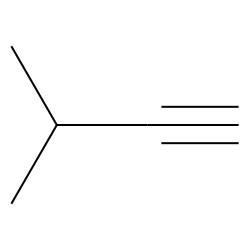
1-Butyne is an organic compound with the formula CH3CH2C≡CH. It is a terminal alkyne. The compound is a common terminal alkyne substrate in diverse studies of catalysis. It is a colorless combustible gas. In 2017, 3.9 million pounds (1,700 long tons) was produced in the USA.
1-Butyne participates in reactions typical for terminal alkynes, such as alkyne metathesis, hydrogenation, condensation with formaldehyde. Based on its heat of combustion, it is slightly more stable than its isomer 2-butyne.
The combustion of 1-Butyne produces propargyl radicals, a pre-cursor to soot and polycyclic aromatic hydrocarbons, as the propargyl radicals can form basic aromatic rings, making butyne's fuel usage a concern for emissions.
1-Butyne is in unsatutared C4 petroleum cuts, and has to be separated out in industrial hydrorefining to make 1-butene, which is used to make low density polyethylene and polybutene. Distillation is impractical due to similar boiling points, so 1-butyne is removed by catalytic hydrogenation. Usually the catalyst is palladium, operated with liquid hydrocarbon and hydrogen gas at 20-60°C and pressures up to 10 bar.
See also
- 2-Butyne
- Butadiene
- Cyclobutene
References
External links
- NIST Chemistry WebBook page for 1-butyne