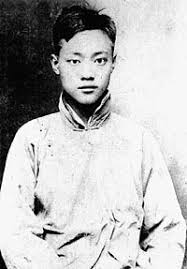
Li Yaotang (simplified Chinese: 李尧棠; traditional Chinese: 李堯棠; pinyin: Lǐ Yáotáng; 25 November 1904 – 17 October 2005), better known by his pen name Ba Jin (Chinese: 巴金; pinyin: Bā Jīn) or his courtesy name Li Feigan (Chinese: 李芾甘; pinyin: Lǐ Fèigān), was a Chinese anarchist, translator, and writer. In addition to his impact on Chinese literature, he also wrote three original works in Esperanto, and as a political activist he wrote The Family.
Name
He was born as Li Yaotang, with alternate name Li Feigan or Li Pei Kan (in Wade–Giles). The first word of his pen name may have been taken from Ba Embo, his classmate who committed suicide in Paris, which was admitted by himself, or from the first syllable of the surname of the Russian anarchist Mikhail Bakunin; and the last character of which is the Chinese equivalent of the last syllable of Russian anarchist Peter Kropotkin (克鲁泡特金, Ke-lu-pao-te-jin).
Biography
On November 25, 1904, Li Yaotang was born in Chengdu, Sichuan Province, into a wealthy Li family. The family's wealth came mainly from the land acquired by his grandfather and father when they were officials, and Li Yaotang sometimes described his family as a "typical landlord's family". In 1919, Ba read Kropotkin's An Appeal to the Young and converted to anarchism.
It was partly owing to boredom that Ba Jin began to write his first novel, Miewang 灭亡 (“Destruction”). In France, Ba Jin continued his anarchist activism, translating many anarchist works, including Kropotkin's Ethics, into Chinese, which was mailed back to Shanghai's anarchist magazines for publication.
During the Cultural Revolution, Ba Jin was heavily persecuted as a counter-revolutionary. In his memoir, Ba Jin also wrote about his own participation in the persecution of friends and acquaintances.: 64 He asked that a Cultural Revolution Museum be set up in 1981. Ba Jin stated that such museums could include "concrete and real objects" and reconstruct "striking scenes" of the Cultural Revolution in order to engrave the upheaval of the period in Chinese national memory.: 64
The Shantou Cultural Revolution Museum referenced the influence of Ba Jin on its establishment through displaying a depiction of his at the entrance as well as a quote of his, "Every town in China should establish a museum about the Cultural Revolution."
Ba Jin's works were heavily influenced by foreign writers, including Émile Zola, Ivan Turgenev, Alexander Herzen, Anton Chekhov, and Emma Goldman.
His wife since 1944, Xiao Shan, died of cancer in 1972.
Ba Jin suffered from Parkinson's disease beginning in 1983. The illness confined him to Huadong Hospital in Shanghai from 1998.
Bibliography
English translations
- (1954) Living Amongst Heroes. Beijing: Foreign Language Press.
- (1958) The Family. (trans. Sidney Shapiro) Beijing: Foreign Language Press.
- (1959) A battle for life: a full record of how the life of steel worker, Chiu Tsai-kang, was saved in the Shanghai Kwangrze Hospital. Beijing: Foreign Language Press.
- (1978) Cold Nights (trans. Nathan K. Mao and Liu Ts'un-yan) Hong Kong: Chinese University press.
- (1984) Random Thoughts (trans. Germie Barm&ecute). Hong Kong: Joint Publishing Company. (Partial translation of Suizianglu)
- (1988) Selected works of Ba Jin (trans. Sidney Shapiro and Jock Hoe) Beijing: Foreign Language Press. (Includes The Family, Autumn in Spring, Garden of Repose, Bitter Cold Nights)
- (1999) Ward Four: A Novel of Wartime China (trans. Haili Kong and Howard Goldblatt). San Francisco: China Books and Periodicals, Inc.
- (2005) "How to Build a Society of Genuine Freedom and Equality"(1921), "Patriotism and the Road to Happiness for the Chinese"(1921) and "Anarchism and the Question of Practice"(1927) in Anarchism: A Documentary History of Libertarian Ideas, Volume 1: From Anarchy to Anarchism (300CE-1939), ed. Robert Graham. Montreal: Black Rose Books.
- (2012) Ward Four: A Novel of Wartime China (trans. Howard Goldblatt). San Francisco: China Books and Periodicals, Inc. ISBN 9780835100007.
Ba Jin stories in collections
- Arzybasheff, M. (1927). "Morning Shadows?" in Tales of the Revolution. Tr. Percy Pinkerton. New York Huebsch.
- (1927). "Workingman Shevyrev." in Tales of the Revolution, tr. Percy Pinkerton. New York: Huebsch.
Works
See also
- 8315 Bajin
- Li Xiao
- Former Residence of Ba Jin
- List of Chinese authors
- Chinese literature
- Esperanto in China
References
Further reading
- Ayers, W. (1950). "Shanghai Labor and the May Thirtieth Movement," Papers on China, 5:1-38. Harvard University, East Asian Research Center.
- Bao-Puo. (1925). "The Anarchist Movement in China: From a Letter of a Chinese Comrade." Tr. from the Russian, in Freedom. 39.423:4.
- (1953). "The Society for Literary Studies, 1921-1930." Papers on China. 7:34-79. Harvard University, East Asian Research Center.
- Chen, Chang; Liu, Tianyi; Chen, Sihe, eds. (19 September 2023). Routledge Companion to Ba Jin. Routledge. doi:10.4324/9781003432531. ISBN 978-1-003-43253-1.
- Chen Tan-chen. (1963). "Pa Chin the Novelist: An Interview." Chinese Literature. 6:84-92.
- Ch'en Chia-ai character. "Chung-kuo li-shih shang chih an-na-ch'i-chu -i che character (Anarchists in Chinese history); in K'o-lu-p'ao-t'e-chin hsueh-shuo kai-yao. pp. 379-410.
- Hsin ch'ing-nien (1908). "Chinese Anarchist in Tokyo," Freedom, 22.23:52.
- Mao, Nathan K. Pa Chin. Boston: Twayne Publishers, 1978.
- Martin, H. and J. Kinkley, eds. (1992) Modern Chinese writers: self-portrayals. Armonk, NY: M.E. Sharpe.
- Pino, Angel, “Ba Jin and the ‘Arshinov Platform’”. libcom.org
- Pino, Angel, “Ba Jin as Translator,” tr. Ian MacCabe, in Peng Hsiao-yen & Isabelle Rabut (eds.), Modern China and the West: Translation and Cultural Mediation. Leiden-Boston: Brill, “East Asian Comparative Literature and Culture” (2), 2014, 28–105.
- Pino, Angel; Jean Jacques Gandini (Introductionà; Paul Sharkey (Traduction) (10 March 2013). Ba Jin On Anarchism and Terrorism. ChristieBooks.
- Razak, Dzulkifli Abdul (Oct. 30, 2005). "Leaving behind their legacies". New Straits Times, p. F9.
- Renditions Autumn 1992. No. 38. "Special issue on Twentieth Century Memoirs. Reminiscences by well-known literary figures, including Zhu Ziqing, Ba Jin, Lao She and Wang Xiyan."
- Revered Chinese Novelist Ba Jin, 100, The Washington Post 17 October 2009.
Films
- Return from Silence: Five prominent and controversial Chinese writers speak on their roles in the modernization of China. (1 hour video cassette available) — The life and work of five esteemed Chinese writers whose modern classics shaped China's past: Ba Jin, Mao Dun, Ding Ling, Cao Yu, and Ai Qing. Produced by Chung-wen Shih, George Washington University, 1982.
External links
- "Literary witness to century of turmoil" China Daily (2003-11-24)
- "Chinese literary icon Ba Jin dies" (BBC)
- A giant of Chinese literature "A giant of Chinese literature" ~ The Sydney Morning Herald' (21 October 2005)]
- Ba Jin at Anarchist Archives
- "When the Snow Melted" Translated by Tang Sheng at Words Without Borders
- Pa Chin: A Literary and Revolutionary Chinese Anarchist ~ YemenTimes Newspaper Archived 2011-06-08 at the Wayback Machine
- Ba Jin: Life and Works
- Ba Jin. A Portrait by Kong Kai Ming at Hong Kong Baptist University Library